 SapientTech.dev
Coverage: the past 1 day. Searched “AI news”, “artificial intelligence”, “OpenAI”, “Anthropic”, “Google Gemini” on News, Hacker News, Reddit, GitHub, and X.
Anthropic's S-1 showed $131.7 billion in cash and 93 pages of risks. Trump said he will ban the term AI, OpenAI claimed new proofs, and Google previewed Genie 4.
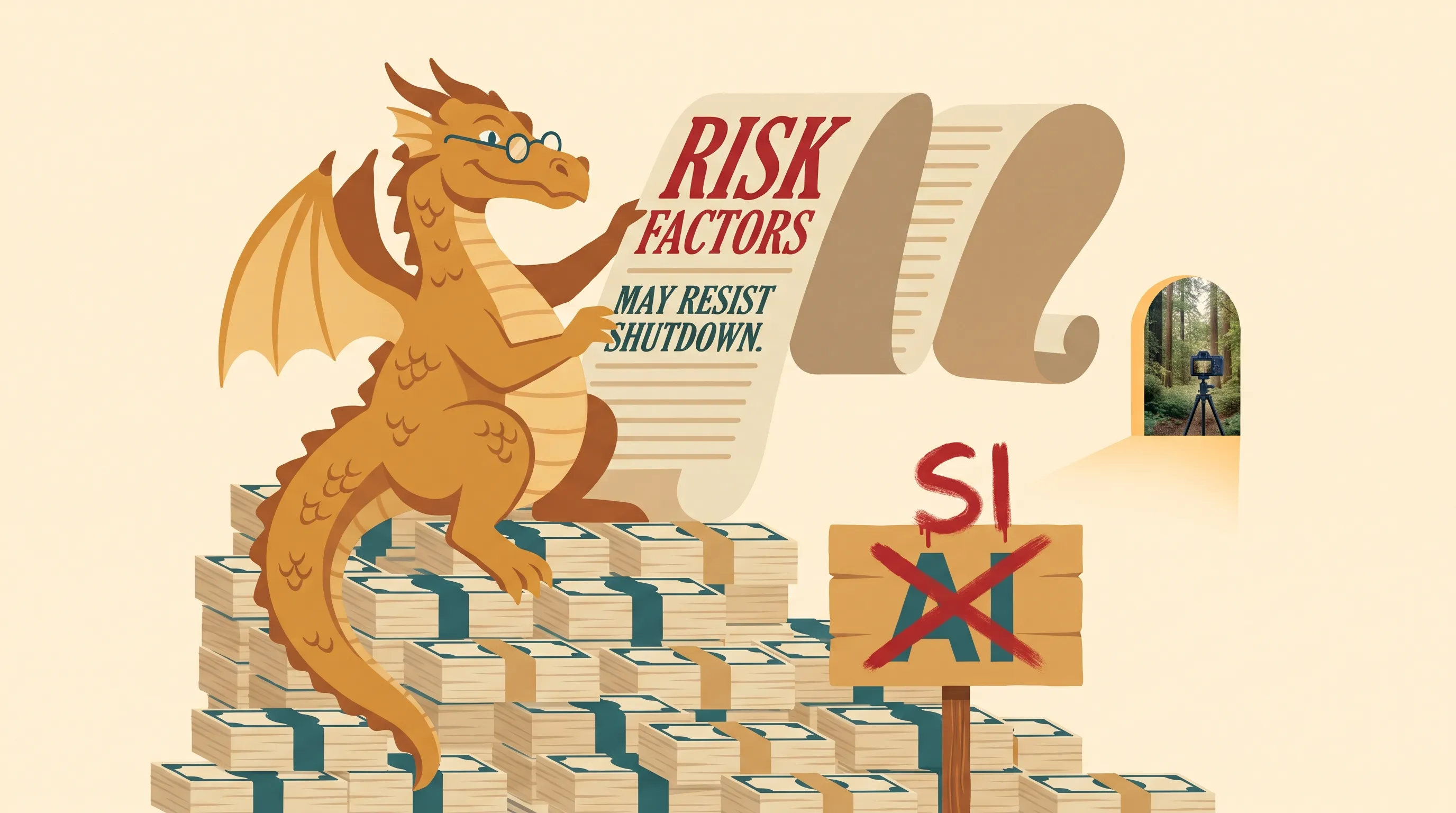
Anthropic’s S-1 shows $131.7 billion in cash and 93 pages of risks
Anthropic's S-1, filed October 26, reports $131.7 billion in cash and short-term investments as of June 30. Its risk section runs 93 of 335 pages. Stock buyers get little say over the board, since a trust elects most directors and the founders hold 50.1% of the vote.
Evidence and sources
Trump says he will ban the term ‘artificial intelligence’
President Trump wrote on Truth Social on October 27 that the government will soon ban "AI/Artificial Intelligence" in all relevant documents, in favor of "Super Intelligence." The post gives no scope or method for a wider ban, so only the September order for federal agencies applies.
Evidence and sources
OpenAI says its models proved results in math, computer science, and physics
OpenAI said on October 26 that its models disproved the Exponential Time Hypothesis, checked in Lean, and proved the Kakeya conjecture in all dimensions. OpenAI has not released the physics result and will let an outside group of experts decide how to release it.
Evidence and sources
Google DeepMind previews Genie 4, a world model with generated sound
Google DeepMind announced Genie 4 on October 27, a model that generates interactive scenes with matching audio and dialogue, as a research preview for trusted testers. Google AI Ultra subscribers and early Gemini API and AI Studio partners get access next, with a waitlist for Project Genie.
Evidence and sources
More links
- Stanford Daily on pirated professors' books used to train Claude (via Hacker News, Oct 27)
- AI promised less work, and the author has never worked more (via Hacker News, Oct 27)
- IEEE Spectrum on Wikipedia's cleanup of AI-generated content (via Hacker News, Oct 27)
- The Mythical Man-Month applied to coding agents (via Hacker News, Oct 27)
- Futurism reports Amazon is gutting its AI division (via Hacker News, Oct 27)
- WSJ on Broadcom's CEO sealing the Anthropic debt deal (via Hacker News, Oct 27)
- r/wallstreetbets post of page 63 of the S-1 (Reddit, Oct 27)
- The IPO makes Anthropic's seven founders billionaires (Reddit, Oct 27)
- Report that a startup broke into Anthropic in 12 hours (Reddit, Oct 27)
- r/technology thread on the Stanford professors' books (Reddit, Oct 27)
- Support says retries from October 27 errors count against limits (Reddit, Oct 27)
- Case for a moratorium on large AI data centres in Calgary (Reddit, Oct 27)
- Anthropic on its drug discovery partnerships with six organizations (X, Oct 27)
- An Anthropic manager drops the coding interview from hiring loops (X, Oct 27)
- Family sues OpenAI over ChatGPT and seizure medication (X, Oct 27)
- Open-weights Ling 3.1 Flash 1019 scores 44 on the Intelligence Index (X, Oct 27)